AI Transforms Workplace By Adapting To Humans
AI Transforms Workplace By Adapting To Humans
I've seen a concerning pattern throughout my years consulting with international corporations. Employees spend their days jumping between screens, filling out arcane forms, and navigating byzantine interfaces. Their time vaporizes into systems designed for machines rather than people. By day's end, exhaustion sets in, but what did they accomplish? The hamster wheel spins on.
This reality frustrates me deeply. We've created digital environments that force humans to behave like machines just to operate machines. The cost? Disengaged employees who waste countless hours on tedious interactions with poorly designed systems.
My company is building something fundamentally different – a framework that lets users interact with systems in ways that feel natural and human. We're creating a new paradigm where technology adapts to people, not the reverse.
The Digital Workplace Crisis No One Talks About
Corporate technology today remains staggeringly unfriendly. After decades of development and millions spent on UX studies, enterprise software still presents inconsistent interfaces, overwhelming complexity, and mind-numbing repetition.
Buttons appear in different locations on every screen. Forms contain hundreds of fields when you need only five. Employees waste precious hours copying information between systems and performing the same tasks repeatedly.
The worst part? Most employee training focuses not on business skills, critical thinking, or strategic understanding, but on operating these byzantine systems – memorizing which buttons to click, which forms to complete, and which arcane processes to follow.
We're training people to behave like machines in order to operate machines.
This fundamental contradiction drives workplace dissatisfaction and destroys engagement. The very tools meant to empower employees instead drain their creativity and energy.
How AI Personalization Inverts The Paradigm
What happens when we flip this relationship? When technology finally adapts to us?
AI personalization creates this paradigm shift. Its power extends beyond automating tasks – it fundamentally changes how we interact with workplace technology.
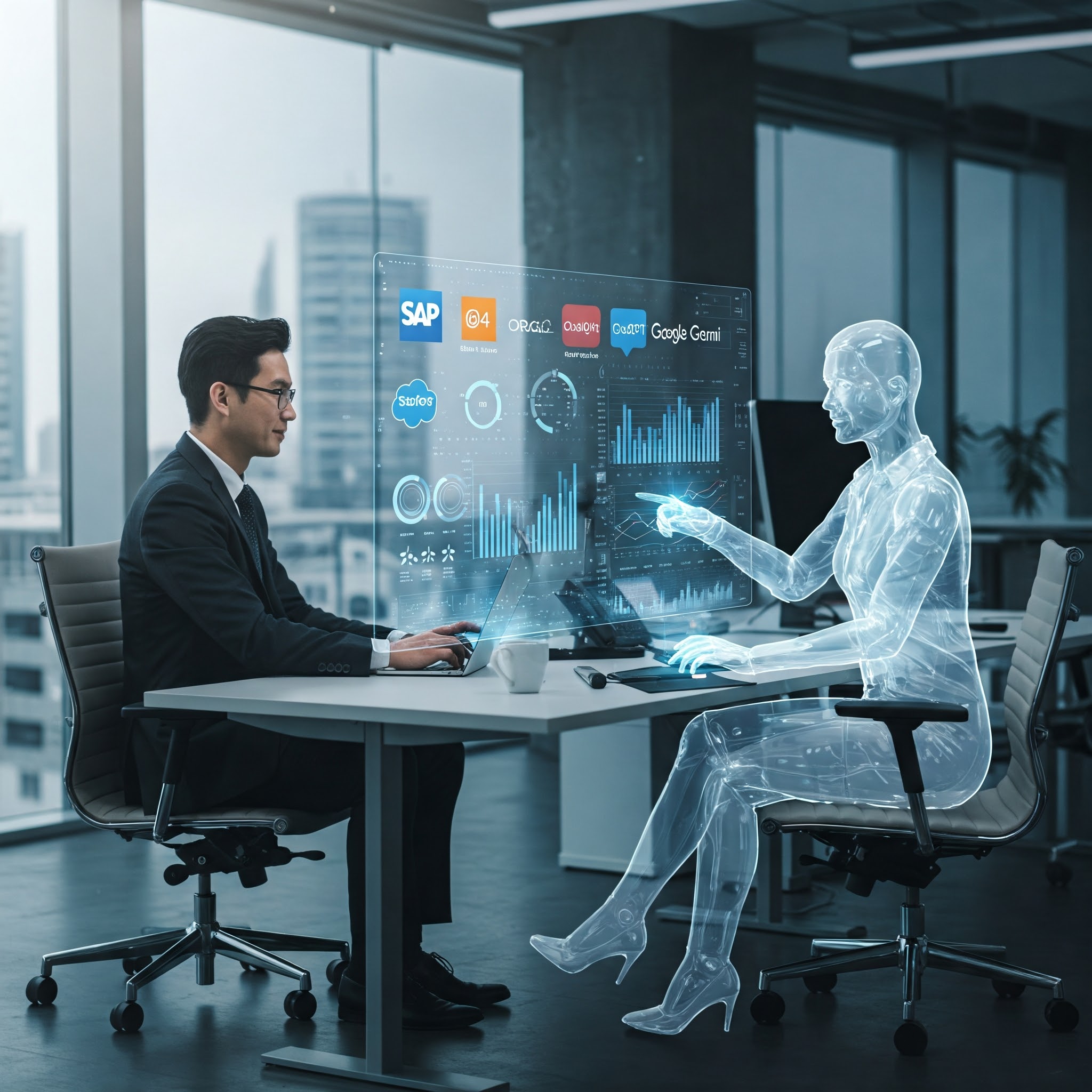
I envision a future where digital coworkers, powered by agentic AI, handle those mundane tasks that consume our days. These systems replace traditional interfaces entirely, working behind the scenes to complete tedious work automatically.
Imagine speaking naturally to your systems instead of clicking through endless menus. Imagine never entering another purchase order or searching through documents again. Imagine ending your day with a clear sense of accomplishment because you spent it on work that matters.
AI personalization makes this possible. By understanding individual needs, preferences, and work styles, it creates interactions tailored to each employee – adapting to their unique approach rather than forcing standardization.
Psychological Impact of AI Personalization
The transformation goes beyond convenience. The psychological impact of personalized workplace technology runs deep.
When digital coworkers handle routine tasks, human employees focus on high-value activities that require uniquely human capabilities: analysis, creativity, strategic thinking, and empathy.
This shift changes what "doing work" means. Rather than focusing on operational execution – the mechanics of getting things into systems – employees concentrate on the actual purpose of their work: solving problems, improving processes, serving customers better, and driving business forward.
One significant frustration employees express is feeling trapped in that hamster wheel – running all day without visible progress. By removing repetitive tasks, AI allows workers to experience tangible accomplishment, see their impact, and feel genuine satisfaction.
This transformation also redefines skill development. When employees no longer struggle with complex system operations, they develop business acumen, analytical skills, strategic thinking, and emotional intelligence – capabilities that provide more fulfilling career paths and create more value for organizations.
From Fragmented Tools to Comprehensive Experience
Many organizations approach AI personalization with point solutions – isolated tools addressing specific problems without considering the broader work environment. While these solutions deliver incremental improvements, they create a fragmented digital landscape adding to employee frustration.
Effective personalization requires a holistic approach aligning with overall company strategy and offering a consistent experience across functions, departments, and processes.
Forward-thinking organizations adopt platforms that are flexible and agnostic to backend systems. These platforms incorporate the latest AI innovations while maintaining a cohesive user experience, breaking down silos between departments, and supporting overall strategic goals.
My team created our OnePilot framework with this understanding. It's a codeless framework configured by AI agents, providing a completely new concept of user interface powered by agentic AI. It integrates with enterprise systems like ERP and banking systems, allowing natural interactions through conversation, gestures, or chat.
This comprehensive approach transforms the entire work experience in consistent, meaningful ways rather than simply addressing isolated pain points.
The Essential Balance of Human and Machine
Personalized AI systems require thoughtful governance. The probabilistic nature of AI models creates challenges not present in traditional deterministic systems where the same input always produces the same output.
As James Landay, professor of computer science at Stanford University, explains: "AI systems are based on probabilistic models, these large neural networks trained on billions or trillions of bits of data. And you can feed data into them and receive different results, depending on how that data's processed in that huge neural network. That means they're harder to design and it's harder to protect against what they might do when they do something wrong."
This characteristic makes robust data governance and human oversight essential. We need guardrails ensuring AI recommendations remain appropriate, accurate, and aligned with organizational values.
The most effective approach combines AI capabilities with human judgment. AI handles pattern recognition, data processing, and routine tasks, while humans provide oversight, ethical guidance, and contextual understanding.
Organizations implementing personalized AI should establish clear governance policies defining when AI can act autonomously and when human review becomes necessary. These policies must balance efficiency with appropriate oversight.
Building Trust in Personal Digital Coworkers
Despite their potential, implementing AI personalization faces significant challenges. The most fundamental? Fear – fear of job loss, security risks, ethical concerns, and the unknown.
Addressing these fears requires acknowledging them directly. Organizations must recognize legitimate concerns about AI implementation and address them through education, transparency, and gradual implementation.
Successful companies often begin by forming AI adoption groups bringing together stakeholders from across the organization. These cross-functional teams develop comprehensive strategies aligning with business goals while addressing security, ethical, and implementation concerns.
The most successful approaches recognize that AI adoption represents not just technological change but cultural and strategic transformation. It requires careful planning, clear communication, and genuine sensitivity to employee concerns.
By demonstrating how AI personalization enhances rather than threatens employee roles, organizations build the trust necessary for successful implementation.
The Surprising Truth About Human Value
As AI handles repetitive tasks, something counterintuitive happens: the uniquely human aspects of work become more important, not less.
Empathy, moral judgment, creativity, ethical reasoning, and authentic human connection – capabilities that AI can only simulate – become the differentiating factors in organizational success.
We see this reality in our implementations. When digital coworkers handle routine tasks, human employees find more space for creativity, innovation, and meaningful connection. They bring their full selves to work rather than compartmentalizing their human qualities to operate like machines.
Organizations implementing AI personalization should identify and celebrate the uniquely human contributions their employees make. They should create opportunities for these qualities to shine and ensure recognition systems reward these contributions.
The goal remains making users happy again – allowing them to end each day with a clear sense of accomplishment and purpose.
The Future of Employee Experience
The workplace I envision features digital coworkers and human employees collaborating seamlessly – each focusing on what they do best.
In this future workplace, digital coworkers handle routine processes across departments – from treasury to accounting to purchasing. They collaborate with each other and with human employees, creating a digital infrastructure supporting the entire organization.
The measure of successful technology expands beyond efficiency to include human satisfaction, fulfillment, and wellness. The most valuable implementations make users happy again – allowing them to end each day with a clear sense of accomplishment and purpose.
By inverting the paradigm – making technology adapt to humans rather than the reverse – we create workplaces that are not just more productive but more profoundly human.
Making the Transition
For organizations considering AI personalization, the message is clear: AI will reshape how work happens. Companies can either embrace this transformation or risk falling behind as competitors create more efficient, fulfilling work environments.
This doesn't mean rushing implementation without careful consideration. Organizations should approach AI adoption with both enthusiasm and caution – understanding its transformative potential while recognizing the importance of thoughtful implementation.
The most successful approaches typically include professional guidance, comprehensive assessments, and focus on specific use cases demonstrating value quickly. By starting with targeted implementations showcasing clear benefits, organizations build confidence and momentum for broader transformation.
The goal should be building a digital environment where AI handles routine tasks while humans focus on meaningful work – creating a future where technology empowers people rather than constraining them.
A Personal Vision
I founded my company after years consulting in financial services, risk management, and treasury operations at multinational corporations. I saw firsthand how employees struggled with dehumanizing systems that drained their creativity and engagement.
Together with my co-founder Juliano, we set out to revolutionize the business workspace by offering our solution: the digital coworker. Our mission? Make users happy again!
We want to redefine how humans interact with machines at work – making machines work for humans, not the other way around. We've started by automating vertical processes and now expand to all business areas while continuously improving the user experience.
Our vision culminates in a completely changed way of working. Collaboration between humans and machines will become so natural that the distinction blurs. People will trust their digital coworkers as much as they trust their human colleagues.
AI personalization transforms employee engagement by fundamentally changing how employees interact with workplace technology. By creating systems that adapt to humans rather than forcing humans to adapt to systems, we free employees to focus on meaningful work, experience genuine accomplishment, and bring their full humanity to their professional lives.
And that represents the true promise of AI in the workplace: not just doing things better, but finally making work better for the people who do it.
Dirk Neumann is the founder and CEO of Brisken, a pioneering company developing AI-powered solutions that simplify enterprise workflows and enhance productivity through human-centered design principles.
